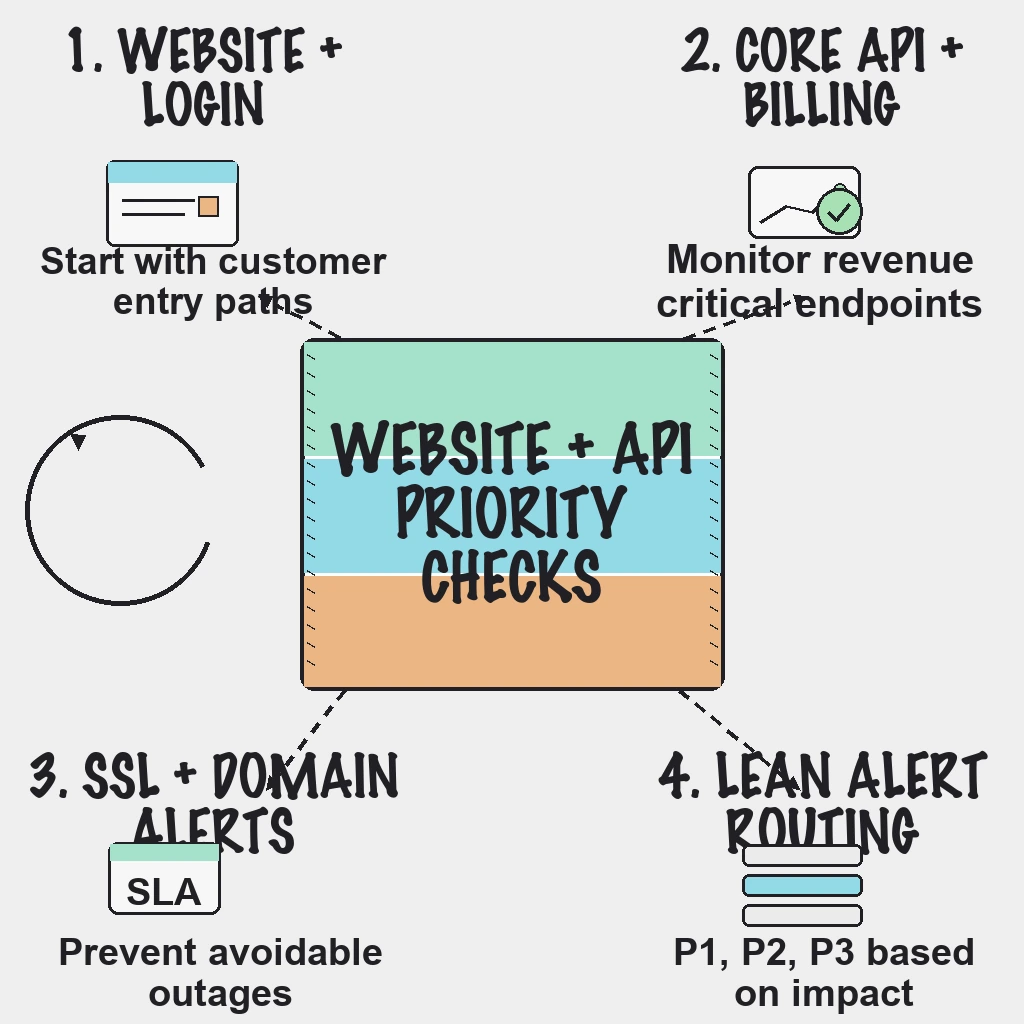
Small teams get better results by monitoring critical customer paths first, then expanding as needed. Monitoring everything from day one usually creates more noise than insight.
Direct Priority Order
- Homepage and login availability.
- Core API endpoints tied to revenue or onboarding.
- Checkout/billing and auth dependencies.
- SSL certificate and domain expiry alerts.
- Public status page communication flow.
What to De-Prioritize at the Start
- Non-critical internal tools without customer impact.
- Dozens of near-duplicate endpoints.
- Paging on transient latency spikes without retry logic.
A practical default: require repeated failures before high-severity escalation.
Actionable Implementation Checklist
Week 1
- List top five user actions that must always work.
- Add external uptime checks for each critical path.
- Set notification channels by severity.
Days 8-30
- Add API checks with auth and response assertions.
- Configure SSL/domain expiry alerts with multiple warning windows.
- Prepare first-incident and recovery update templates.
Days 31-90
- Tune noisy checks and thresholds.
- Map checks to explicit service ownership.
- Run one incident simulation and measure time to first update.
Practical Alert Routing Model
- P1: Customer-facing outage, auth failure, checkout failure.
- P2: Partial degradation or elevated errors.
- P3: Low-impact issues for business-hours handling.
Reader Questions, Answered
How many checks should a small SaaS team start with?
A focused set of 8-15 high-signal checks is a practical starting point.
Should monitoring run from multiple regions?
Yes, especially for customer-facing services, to reduce local-network false positives.
Why include SSL and domain monitoring in uptime strategy?
Certificate and domain failures cause preventable customer-visible outages.
Wrap Up
Lean monitoring is about signal quality, not monitor count.
Ready to deploy a high-signal website and API monitoring baseline for your team?
Related guides:
- Why SMBs leave website monitoring tools
- Uptime monitoring runbook for lean SaaS teams
- How synthetic monitoring helps
- Global website uptime monitoring