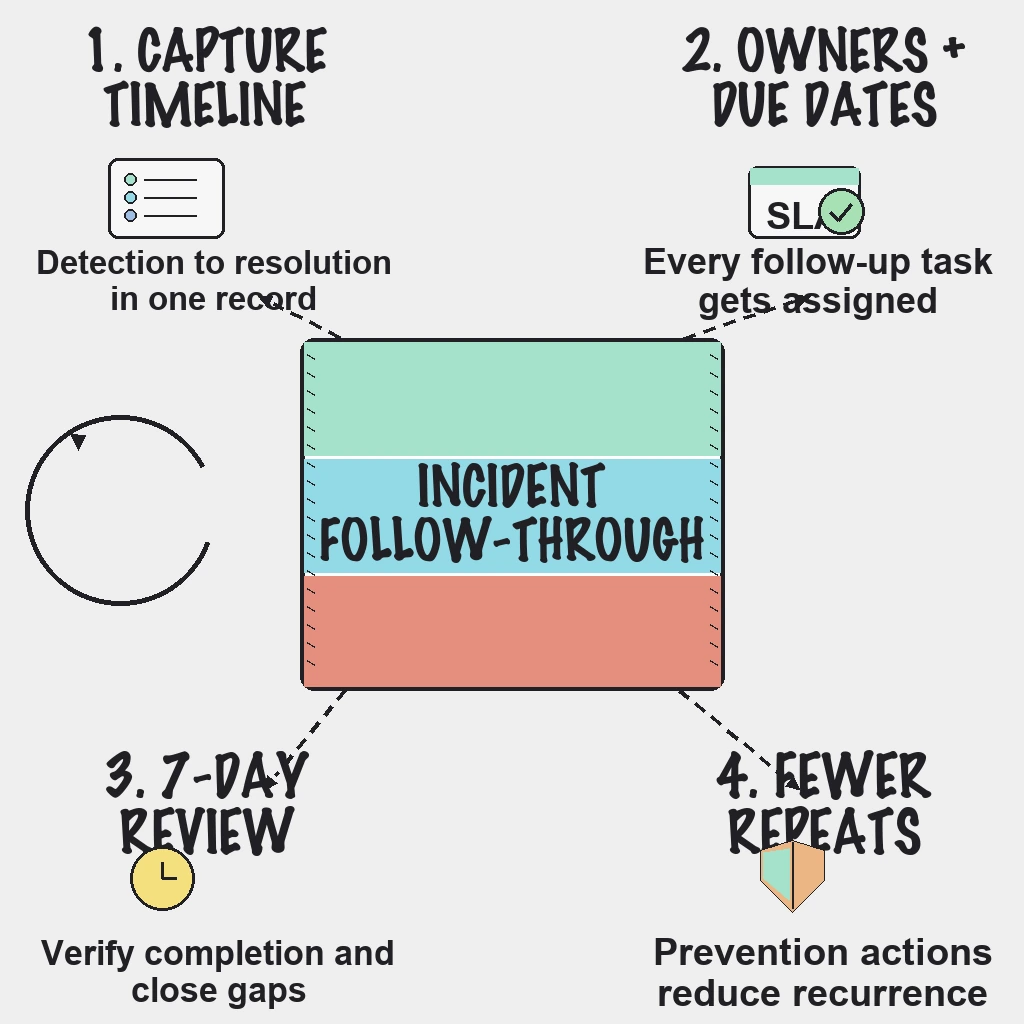
Many reliability teams respond quickly during incidents, then lose momentum after service restoration. That gap is where repeat incidents are born.
Quick Answer
Move every post-incident action from chat into tracked tasks with an owner and due date within 24 hours.
Why This Matters
Detection speed alone does not prevent recurrence. Teams also need operational closure:
- Runbook updates
- Alert tuning
- Root-cause prevention tasks
- Communication process fixes
When these are not tracked, on-call stress increases and reliability regresses.
24-Hour Post-Incident Checklist
- Capture timeline: detection, acknowledgement, mitigation, resolution.
- Publish status summary with impact and outcome.
- Convert follow-up actions into tracker tasks.
- Require owner, due date, and priority for every task.
- Schedule 7-day completion review.
Weekly Reliability Checklist
- Review open follow-up tasks.
- Confirm each incident produced at least one prevention improvement.
- Tune noisiest checks to reduce alert fatigue.
- Audit status updates for clarity and cadence compliance.
- Share short reliability recap with engineering and support.
Status Workflow That Reduces Rework
- Post
Investigatingonce impact is confirmed. - Post
Identifiedwith affected components and active mitigation. - Post
Monitoringafter fix deployment. - Post
Resolvedwith prevention next steps.
Reader Questions, Answered
What is the fastest way to improve incident management quality?
Adopt a closure gate: incident closure requires follow-up tasks in a tracker with owner and due date.
How often should status pages be updated during incidents?
Use time-based updates every 30-60 minutes, even when no major technical change has occurred.
Which metric best predicts repeat incidents?
Follow-up completion rate within seven days is a strong leading indicator for many teams.
Wrap Up
The biggest reliability gains often happen after the outage. Structured follow-through prevents repeats and keeps operations improving.
Ready to run incident response with stronger closure discipline?
Related guides:
- Incident management workflow for SaaS
- MSP uptime monitoring playbook
- Status page best practices for customer trust